
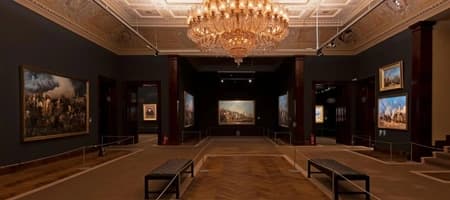
National Palaces Painting Museum Entry with Audio Guide
Price without Pass
Istanbul E-pass includes the National Palace Painting Museum Entry Ticket with Audio guide. National Palace Painting Museum can be entered with Dolmabahce Palace.
The audio guide is also available in English, Russian, Spanish, Arabic, German, French, Italian, Ukrainian, Bulgarian, Greek, Dutch, Persian, Japanese, Chinese, Korean, Hindi, and Urdu languages provided by the Istanbul E-pass live guide.
National Palaces Painting Museum at Dolmabahce Palace
The building that currently houses the National Palaces Painting Museum was originally known as the Crown Prince’s Apartment within the Dolmabahce Palace complex. Constructed during the reign of Sultan Abdulmecid, this historic structure represents a significant shift in the status of Ottoman heirs following the Tanzimat Reforms of 1839. Before these reforms, royal princes were traditionally confined and isolated from public life. The apartment later served as the residence for several Ottoman crown princes, including Sultan Abdulaziz, Sultan Murad V, Sultan Abdulhamid II, Sultan Mehmed V Resad, Yusuf Izzettin Efendi, Sultan Mehmed VI, and Caliph Abdulmecid.
After extensive restoration work, part of the Crown Prince’s Apartment was transformed into the National Palaces Painting Museum and opened its doors to the public on March 22, 2014. The museum quickly gained popularity among art enthusiasts with its remarkable collection showcasing the artistic preferences of the Ottoman court during the 19th and early 20th centuries. It also played a pivotal role in introducing Turkey’s earliest examples of Western-style painting. Between 2014 and 2020, approximately 200 artworks from both the National Palaces Painting Collection and the Topkapi Palace Museum Collection were displayed.
Following the completion of restoration work on the second section of the building, the two areas were unified to create a larger, more comprehensive museum. The upgraded space was enhanced with state-of-the-art exhibition panels, lighting systems, and modern information technologies, aligning it with global museum standards. With the inclusion of collections from Yildiz Palace and Topkapi Palace, the number of artworks in the museum expanded to 553, spanning from the 16th to the 20th century. One of the standout masterpieces in the collection is Prince Halim Hunting Gazelles in the Gatah Desert: Greyhounds’ Share by Félix-Auguste Clément. Originally displayed at the Said Halim Pasha Mansion, it holds the distinction of being the largest Orientalist painting in Turkey.
As part of the museum’s revitalization, the number of thematic galleries increased from 11 to 34. These include:
- Sultan Abdulmecid and Sultan Abdulaziz Hall
- Devlet-i Aliyye
- Salvatore Valéri
- Palace Painters (Ressam-i Hazret-i Sehriyari)
- Ivan Konstantinovich Aivazovsky
- Emilio Della Sudda
- Osman Nuri Pasha
- Suleyman Seyyid
- Turkish Bath Culture
- Halil Pasha
- Ottoman Splendour
- Ahmed Ali Pasha (Seker)
- Impressions of Abdulmecid Efendi’s Studio
- Abdulmecid Efendi
- Osman Hamdi Bey
- Hoca Ali Riza
- Huseyin Zekai Pasha
- Paintings from the Goupil Gallery
- Images of Istanbul
- Ottoman Women
- Mustafa Kemal Ataturk
- Hane-i Saadet
- Portraits of the Sultans
- Ottoman Navy
- Wars and Victories I & II
- Conquest and Conqueror
- Abdulmecid Efendi’s Studio
- On the Orient
- Landscapes at the Ottoman Court
- Palace School-Trained Artists
- Ottoman Bureaucracy
- Portraits
- Gallipoli Galleries
This extensive museum now stands as one of Turkey’s premier cultural institutions, offering an in-depth look into the visual history and artistic evolution of the late Ottoman Empire.
Frequently Asked Questions about National Palaces Painting Museum Entry with Audio Guide
Situated within the historic grounds of the Dolmabahce Palace in Istanbul, the National Palaces Painting Museum showcases a rich collection of artworks from the 19th and early 20th centuries. The museum primarily features paintings that once adorned various Ottoman palaces, offering visitors a glimpse into the empire’s artistic legacy.
Important Notes
- Present your QR code from the E-pass customer panel and get in.
- There is a security control at the entrance.
- You will be asked for an ID or a passport to get a free audio guide. Please make sure to have one of them with you.
- Audio guide can be obtained at the main entrance of the palace.
- Photo ID will be requested from child Istanbul E-pass holders
The museum welcomes visitors daily from 9:00 AM to 5:00 PM, with the exception of Mondays and Thursdays when it remains closed.
The museum’s perse collection includes Ottoman-period paintings created by both European and Turkish artists. Highlights include pieces reflecting the empire’s Westernization period, European Orientalist art, and masterpieces by renowned painter Ivan Konstantinovich Ayvazovsky.
No, photography and video recording are not allowed inside the National Palaces Painting Museum to protect the artworks and preserve the museum environment.
This museum is designed for self-paced exploration. However, visitors can enhance their experience with an audio guide available through the Istanbul E-pass.
Details about accessibility are limited online. For up-to-date information regarding wheelchair access or other facilities, it's best to reach out directly to Dolmabahce Palace administration.